Is Litecoin Undervalued in 2026? Price Prediction, Trading Strategy & Key Data
Is Litecoin Undervalued? What the Data Says (Trading Guide)
Litecoin missed the 2025 breakout and has been stuck between $55 and $59 for months, prompting many traders to ask whether trading sideways or waiting for a breakout is the best approach. Both are valid, but you need to know how you can approach them.
The truth is that missing a cycle does not generally mean that a coin is worthless, though it is common for traders to focus on price action rather than what the team is building.
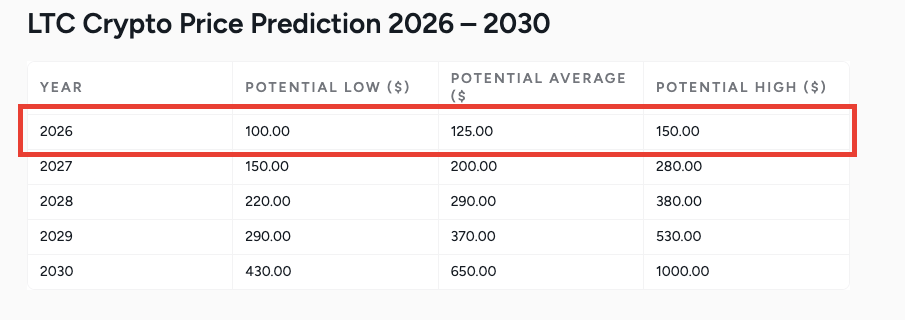
Litecoin was launched three years after Bitcoin was created, but despite its strong fundamentals and expert prediction reaching $150, the price has been less exciting for traders. Long-term holders regret missing the opportunity to sell in 2021 when it reached a new all-time high. It has since fallen by 86.2%.
For personal analysis, we recommend learning to use crypto trading indicators to predict price movements and improve your trading strategy.
Key Takeaways:
- Litecoin is basically one of the oldest altcoins, ranking alongside Ethereum, BNB, and XRP.
- Experts' analysis predicts that Litecoin could potentially hit $150 by the end of 2026.
- Fundamental details such as hashrate, funding rate, market cap, and volume suggest that Litecoin could be undervalued compared to its network.
- Beyond social media, use crypto trading indicators such as the funding rate, the Crypto Fear & Greed Index, and the liquidation heatmap before investing in Litecoin.
Source: coinpedia.org
Disclaimer: This article is for informational purposes only and should not be considered financial or investment advice. We recommend doing your own research before investing.
What is Litecoin?
Litecoin was developed in 2011 by Charlie Lee, based on the Bitcoin protocol. It was expected to work as a lite version of Bitcoin ($BTC), hence, its core design focuses on low mining effort, scalable infrastructure, fast trading speed, and low fees.
On the Litecoin network, you can complete transactions in minutes, paying a fee that is way lower than what you pay on blockchains like Bitcoin or Ethereum. Average network fees stand at 0.0001 $LTC, which is $0.0056 at the time of writing. This fee structure makes it practical for small transfers.
Another impressive feature is its low transaction threshold. You can send as little as $1 worth of Litecoin (LTC).
Litecoin retains the regular features of a crypto asset. It is built on a decentralized infrastructure and is stored in crypto wallets. Transactions are validated using the Proof-of-Work consensus mechanism and recorded on a public ledger for transparency. Also, it often serves as a testing ground for innovations like SegWit and the Lightning Network.
Can Litecoin Reach $150 in 2026?
Many traders are frustrated with Litecoin’s performance, which is fair. However, frustration can also be a good sign. When long-term holders sell due to fear of losing out completely, they create an opportunity for new traders to buy at an undervalued price.
To escape this emotional trap, focus on the network's value and real improvements when setting a trading strategy.
Litecoin vs Bitcoin
Litecoin has long been considered the "silver to Bitcoin’s gold." It gained significant popularity during the 2017 bull market and also hit a new all-time high in the 2021 bull run. Given that Litecoin is expected to follow Bitcoin's price, many anticipate a price recovery if the 2026 bull run materializes.
Currently, Litecoin’s price action follows Bitcoin’s gain closely. Bitcoin has gained over 12% in the last 30 days, and Litecoin has also gained over 8%. However, that may change when rotation flows into altcoins and Litecoin starts decoupe from Bitcoin.
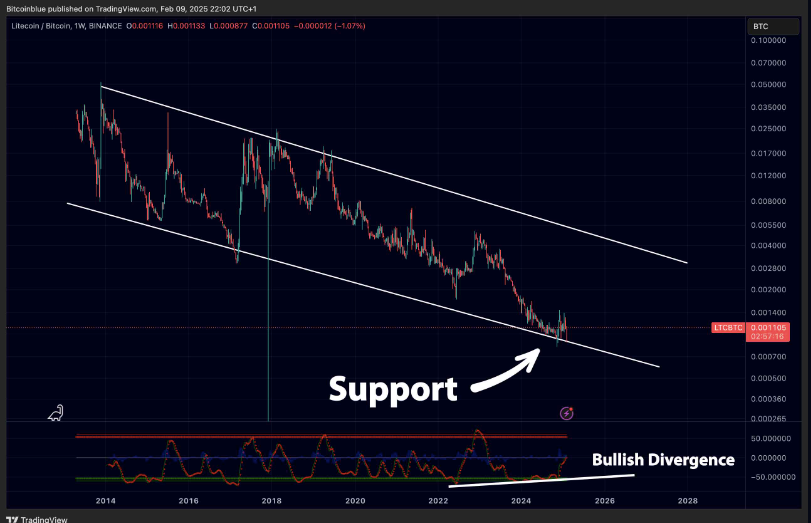
Also, when we look at Litecoin's valuation relative to Bitcoin, we can see that the chart is at a crucial support level. At a key support level, Litecoin is aiming higher, indicating that momentum is building in price action.
Litecoin/Bitcoin Chart (LTC/BTC)
Litecoin vs Altcoins
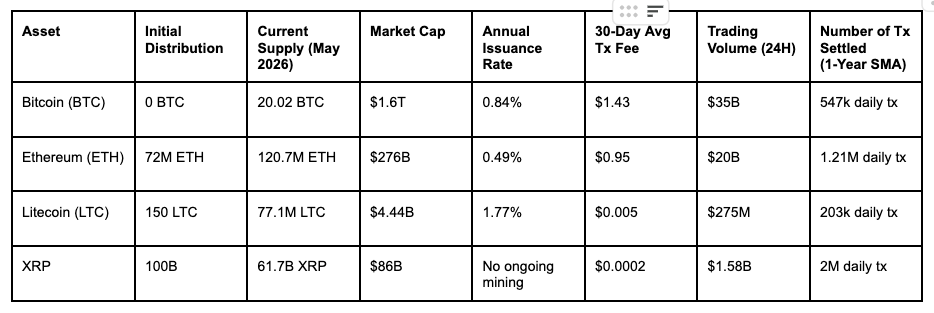
Litecoin is not currently outperforming other altcoins, but its structure signals a potential breakout. At the time of writing, CoinMarketCap's community sentiment shows roughly 80% bullish positioning, and the circulating supply stands at 77.1M LTC.
Also, Litecoin’s transaction fees are significantly cheaper than those of Bitcoin or Ethereum, making it a more efficient network for everyday use.
This combination of high network activity and a low market cap means Litecoin requires far less liquidity to experience substantial price gains. To stay on track, you can confirm liquidity rotation into altcoins by understanding how to use the Alt Season Index.
Litecoin vs XRP and Ethereum
Quick Tip: Instead of focusing only on the Altseason Index, another way to know when Litecoin is structurally weak is to analyze the LTCBTC chart. When the LTCBTC monthly RSI suggests an oversold condition, that is often the phase before a potential rebound.
Why Traders Think Litecoin is Undervalued
Everyone wants Litecoin to rise, but only a few people are looking at the data. We explain five fundamental factors that may impact price movements.
Litecoin Halving
One of the most important upcoming events we cannot ignore is the Litecoin halving, scheduled for July 2027. Halving is the process of slashing mining rewards within the Proof-of-Work ecosystem. This approach simultaneously reduces supply and increases the asset's value.
Back in July 2023, when the reward was halved from 12.5 LTC to 6.25 LTC, the price jumped from $40 to $120 within a short period; however, a correction followed immediately. With the upcoming halving, mining reward will be reduced to 3.125 LTC per block.
Litecoin network Value
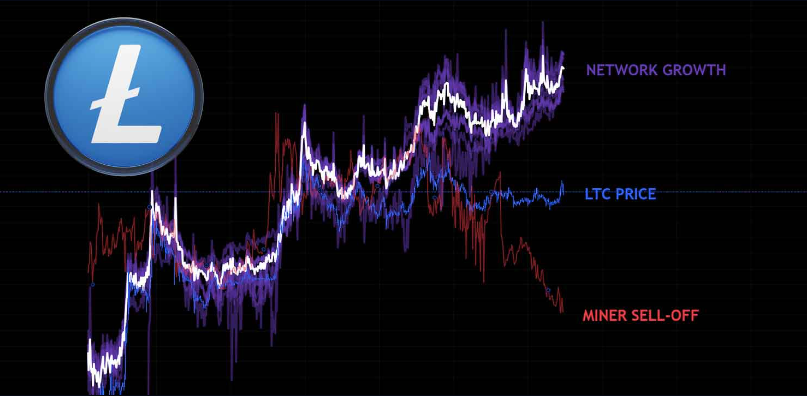
Another key metric to look at is the hashrate, which measures the total computing power used to secure the network. Recently, Litecoin’s hashrate reached an all-time high (2.87 PH/s), indicating that more miners are joining in and supporting the network.
While this shows that the network is becoming stronger and more valuable, the price of Litecoin hasn’t yet reflected this growth. In simple terms, Litecoin's network value is increasing, but its price is still catching up.
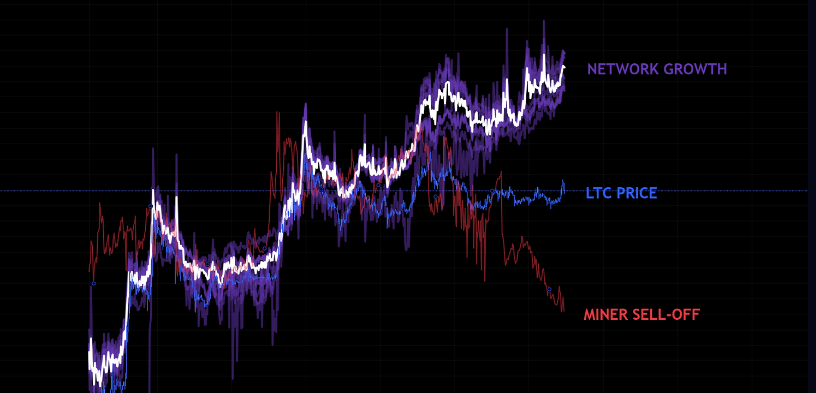
A notable aspect of this chart is that Litecoin miners currently hold record-low amounts of the cryptocurrency. This suggests they have sold off a significant portion of their holdings, which could reduce selling pressure on Litecoin.
Trading Indicators
Litecoin is currently trading at $58 after spending months consolidating between $50 and $59. Open interest sits near $447 million, while futures trading volume has reached $275 million in the last 24 hours. This shows that the market is active, but trading activity is not very high. Also, Litecoin's funding rate remains neutral, indicating a balance between long and short positions.
On-chain indicators support a slightly bullish trend, but the price is not there yet. A break above $59 could shift momentum, but volatility can go either way.
It is easy to miss the minor changes in market conditions, particularly if you are too focused on price action. You can prevent this by learning to use the best crypto trading indicators to analyze charts and data before deciding whether to buy more Litecoin.
What Traders Are Saying About Litecoin
Overall market sentiment is generally bullish while fundamentals remain balanced. This is not something to ignore, and the fact that it aligns with compressed volatility and increased trading interest suggests that Litecoin can easily transition from sideways movement to a stronger trend.
However, users’ opinions are usually unreliable, as they can change at any time in response to a single event. The recent MimbleWimble extension breach led to a temporary halt in transaction finality, drawing attention to the potential risks within the ecosystem. Events like this may affect users' confidence and price over time.
In our previous article, we explained how traders can use the funding rate to spot reversals and predict price action.
Quick Tip: Always use sentiment as a contrarian guide. Historically, when market sentiment signals extreme fear or greed, the reverse happens.
Institutional Interest in Litecoin
Institutional interest and whale focus on Litecoin is also increasing, particularly with the approval of Canary Capital’s Litecoin spot ETF in October 2025 and subsequent ETF filings by major TradFi institutions. This is significant because it provides traditional investors with direct exposure to Litecoin.
Ongoing ETF discussion has repeatedly improved price performance for major altcoins. In 2024, Ethereum jumped by 20% within 2 days, following news of possible ETF approvals.
For full details, you can track the Litecoin ETF using the Block’s Litecoin ETFs chart.
Where to Trade Litecoin: How to Buy Litecoin on Crypto Exchanges
Litecoin is available on popular exchanges like Bybit, Coinbase, and Hyperliquid.
Best Centralized Exchanges to Trade Litecoin
Centralized exchanges like Binance, Bybit, or Coinbase offer the best beginner-friendly platforms for new traders. They support spot and perpetual future trading, and you can easily manage your funds using email and password. They also come with a forgotten password, which means access is never completely lost.
Note that they may carry custodial risks, so we recommend trading on exchanges with strong security, a solid reserve, and transparent wallets.
Another benefit of trading Litecoin in CEXs is that you can explore some of the best crypto bonuses on these exchanges while you trade.
Where to trade litecoin (CEXs): Bybit, Binance, Coinbase, Bitget, Kraken, Bitunix, BloFin and more
Ready to start trading? Buy Litecoin on Bybit
Best decentralized exchanges to trade Litecoin
If you want to retain the custody of your fund, decentralized exchanges like Hyperliquid, AsterDEX, Apex Omni, and dYdX are good alternatives to explore. Another benefit of this option is that the trading fee is lower than on centralized exchanges.
However, a good understanding of web3 wallet security is required to keep access secured. Also, you should always confirm if the DEX has a good reputation among traders.
If you are still wondering which DEX to use for Litecoin trading, we compared the top 5 decentralized exchanges in our previous article to assess their features and functionality.
Where to buy Litecoin (DEXs): Hyperliquid, AsterDEX, Apex Omni, dYdX, and more
Learn how to buy Litecoin on Apex Omni.
Best non-KYC Exchanges to Trade Litecoin
Due to regulatory restrictions and KYC barriers, some exchanges are unavailable in certain countries. For example, you cannot use Binance Global in the United States or the United Kingdom, but you can learn how to use Binance in the US without a VPN.
Non-KYC exchanges eliminate the location barrier because you don’t have to verify your identity to trade. Most decentralized exchanges fall under this category, but there are decent non-KYC centralized exchanges you can explore.
Where to trade Litecoin (non-KYC): Apex Omni, Bitunix, BTCC, and Phemex Exchange.
What is the Best Trading Strategy for Litecoin?
Everyone on social media will tell you to buy Litecoin, but the truth is, trading requires a strategy. This is why understanding how and why the market moves is essential. Reading charts does not guarantee a 100% win rate, but it can help you reduce emotional trading.
Before you buy Litecoin or start trading, you should learn how to combine multiple indicators for price prediction. With that, you can access all important data and adjust your trading goal accordingly.
For instance, combining liquidity heatmaps with macro tools like RSI, EMA Ribbon, and heatmaps is vital for leveraged traders when predicting day-to-day price action.
How To Set Up A Good Trading Strategy for Litecoin
Traders can approach trading Litecoin differently. Long-term can benefit from its growth potential, but you may still need to hold for some months (if not years). It is also a good choice for grid traders who are only interested in profiting from small price changes, rather than chasing a big pump. Regardless of your approach, you will find this 3 points useful:
- Determine your trading goal: Decide whether you want to hold or trade the range for consistent profits. For long-term investors, focus on buying when other traders are scared and selling when others are caught up in FOMO. Alternatively, you can use DCA to accumulate quietly and hedge against volatility.
- Use leverage that aligns with your risk appetite: Crypto exchanges like AsterDEX offer up to 1001x leverage, but using high leverage increases the risk of liquidation.
For leverage traders, the key is to find a good entry and set a low leverage. You can then gradually take profits at 25%, 50%, and 75% if the upward movement is sustained.
- Consider BTC Dominance and the Altseason Index: Litecoin is a leading altcoin, which means it benefits when Bitcoin starts losing dominance. Right now, Bitcoin is outperforming other coins because dominance is at 60%, which is pretty high. When the dominance is low, liquidity will rotate into solid altcoins.
Risk of Trading Litecoin: Things To Keep In Mind
- Slower Moves: Market leaders have been predicting a breakout since 2024, yet it has yet to materialize.
- Low hype: Hype around recovery is fading out, which may affect price recovery.
- Altseason is still months away: Bitcoin dominance sits at 60, which is high for an all-around alt season.
- Volatility risk: In the crypto space, nothing is 100% certain. Price can dump and pump unexpectedly.
- Upgrade Alert: Always follow the Litecoin community for updates. Following the recent attack on the Litecoin MimbleWimble privacy extension, users were advised to upgrade to Core v0.21.5.5. See the full details on the Litecoin MWEB update.
Final Thought: Is Litecoin A Good Investment in 2026?
Though the recent change in regulatory sentiment has increased institutional interest in Litecoin, trading activity remains less volatile. A close look at the Litecoin chart shows that the price is moving toward a slow recovery. While many traders, particularly long-term holders, expected an aggressive pump, Litecoin has remained between $55 and $59.
What to watch is whether Litecoin breaks the $60 resistance and buying pressure remains sustainable. If that happens, then we could see a breakout; however, a pullback is also possible, especially if the price dips below $50.
Interested in buying Litecoin? Buy this token on Bybit.
Frequently Asked Questions
How can I predict the Litecoin price accurately?
You can’t predict Litecoin price with 100% accuracy, but using a mix of crypto trading indicators (trend, volume, sentiment) can help you predict market direction and manage risk efficiently.
What is DCA?
DCA (Dollar-Cost Averaging) is a trading strategy that allows traders to buy crypto assets gradually over time. It essentially lowers the risk of buying at the top or missing out on a good price.
Where Can I Buy Litecoin?
You can buy Litecoin on popular centralized and decentralized exchanges like Bybit, Binance, Hyperliquid, Apex Omni, and other exchanges. If you are looking for an exchange without KYC barriers, decentralized exchanges are the best option. See our Hyperliquid tutorial article to get started.
What is Litecoin's ATH?
Litecoin reached an all-time high in May 2021, with the price hitting $412.96.